
How Mindfulness Helps Employees Perform Under Pressure
If you work in HR, you've probably watched it happen more times than you'd like: a looming deadline, a difficult client call, a reorg announcement, and suddenly the whole team seems to be running on fumes. Tempers get shorter. Emails get sharper. Good people start making avoidable mistakes. It's not that they don't care, it's that they're stretched past the point where their brains can do their best work.
This is where workplace mindfulness earns its keep. (You can read more about our approach to mindfulness training on our About page.) Far from being a soft perk or a trendy add-on to your wellbeing calendar, mindfulness is one of the most practical, evidence-backed tools available for helping employees think clearly and perform well when the stakes are high. In this guide, we'll unpack exactly how mindfulness improves workplace performance under pressure, the science behind it, and how HR teams can build it into a genuine employee wellbeing program, not just a one-off workshop that gets forgotten by February.
Why Workplace Pressure Has Become an HR Priority
Pressure at work isn't new, but its scale is. According to the American Psychological Association's 2025 Work in America survey, more than half of U.S. workers say job insecurity is significantly affecting their stress levels, and a large share are worried about their roles changing or disappearing altogether (APA, 2025). The picture isn't much better globally: Gallup's Global Workplace Report found that around four in ten employees experience "a lot of stress" on a given day, and Gallup has separately estimated that diminished employee wellbeing drained hundreds of billions of dollars from the global economy in 2024 alone (Gallup data cited in SSR, 2026).
For HR leaders, this isn't an abstract statistic, it shows up as absenteeism, presenteeism, burnout-driven turnover, and a workforce that's technically "at work" but not really there. And here's the uncomfortable part: most organisations know it. A 2025 industry survey of over 200 HR professionals found that while stress shows up in roughly eight in ten organisations, fewer than three in ten HR teams believe their organisation is effective at helping employees manage it (HR.com, 2025).
That gap- between knowing stress is a problem and having a workable workplace stress management strategy- is exactly where mindfulness training fits in.

What Workplace Mindfulness Actually Means (No Jargon, Promise)
Strip away the incense-and-yoga-mat stereotype, and mindfulness at work is simply this: the practice of paying deliberate attention to the present moment, without judgement, so you can respond to what's actually happening rather than what your stress response thinks is happening.
In a corporate context, that might look like:
A 60-second breathing reset before a tense meeting
A guided body scan during a lunch break
A short group meditation to open a Monday all-hands
A "single-tasking" habit that replaces constant multitasking
None of this requires employees to sit cross-legged on the floor. Corporate mindfulness is about building small, repeatable moments of awareness into the existing rhythm of the workday- which is exactly why it scales so well across busy teams.
How Mindfulness Improves Workplace Performance Under Pressure
It Sharpens Focus and Concentration
When we're under pressure, attention scatters. We reread the same email three times, jump between tabs, and lose the thread of what we were doing. Mindfulness training works directly on this problem by strengthening what psychologists call "attentional control"- the ability to choose where your focus goes, rather than being yanked around by every notification and worry.
A meta-analysis of workplace mindfulness-based programs, published in the journal Mindfulness, found that these programs meaningfully reduce perceived stress and health complaints while improving wellbeing and work-related outcomes such as engagement, productivity, and job satisfaction (Springer, 2020). If you're looking for how to improve focus and concentration at work, this is one of the few interventions with genuine research behind it, rather than just good marketing.
It Helps Employees Respond Rather Than React
This might be the single most valuable shift mindfulness creates. Under pressure, our default is reactive: a sharp email gets a sharper reply, a criticism triggers defensiveness, a mistake triggers panic. Mindfulness builds a small but crucial gap between stimulus and response, just enough space to ask, "What's actually needed here?" before acting.
Learning how to respond rather than react at work is less about suppressing emotion and more about noticing it early enough to choose a better next move. Over time, this reduces the kind of impulsive decisions and heated exchanges that HR teams so often end up mediating.
It Improves Decision-Making Under Stress
Chronic stress narrows our thinking. We default to familiar patterns, even when the situation calls for something new. Mindfulness training counteracts this by improving what's sometimes called cognitive flexibility: the ability to hold multiple possibilities in mind and choose thoughtfully rather than defaulting to autopilot.
Research summarised in the Harvard Business Review notes that mindfulness is associated with heightened attention, improved decision-making, and greater emotional regulation, particularly when it's introduced thoughtfully and matched to the demands of the role. For teams making fast, high-consequence calls, sales negotiations, client escalations, safety-critical work- that clearer thinking has a direct line to performance.
It Strengthens Workplace Communication
Miscommunication tends to spike exactly when pressure is highest — which is, unhelpfully, exactly when clear communication matters most. Mindfulness for better workplace communication works by improving self-awareness (so people notice their own tone and triggers) and by improving listening (so people are actually absorbing what a colleague is saying, rather than mentally drafting their reply).
Teams that practice mindfulness together often report fewer flare-ups in meetings and a greater willingness to ask clarifying questions instead of assuming the worst.
The Science: How Mindfulness Reduces Workplace Stress
It's worth being honest here: mindfulness isn't a silver bullet, and the research reflects that nuance. A rigorous meta-analysis of workplace mindfulness-based programs, covering more than 5,000 participants across 56 studies, found effect sizes ranging from small to medium for reducing stress and improving work outcomes — meaningful, but not miraculous. Similarly, a field study of a workplace mindfulness intervention reported large improvements in mindfulness itself, alongside moderate reductions in burnout and perceived stress, and smaller but real gains in team climate and personal performance (NCBI, 2018).
The honest takeaway for HR professionals: mindfulness works best as one well-implemented part of a broader corporate wellbeing program, not a stand-alone fix for a toxic culture or an unsustainable workload. Used well, though, it's one of the few interventions that employees can apply themselves, in real time, the moment pressure hits.
Mindfulness Techniques for Workplace Stress You Can Start Today
You don't need a full workplace mindfulness training rollout to see benefits. Here are practical mindfulness exercises for employees that take less than five minutes and need no equipment:
The 4-7-8 breath — Inhale for 4 seconds, hold for 7, exhale for 8. Repeat three times before a stressful meeting to calm the nervous system.
The one-minute body scan — Briefly notice tension from head to toe. Awareness alone often releases some of it.
Single-tasking sprints — Pick one task, close every other tab, and work on it exclusively for 10–15 minutes.
The STOP technique — Stop, Take a breath, Observe your thoughts and feelings, Proceed with intention. Ideal for how to stay calm under pressure at work in the moment.
Mindful transitions — A 30-second pause between meetings, instead of racing straight from one to the next, to reset attention.
Gratitude check-ins — Naming one specific thing that went well shifts the nervous system out of threat mode.
These small habits are especially useful for mindfulness for high-pressure workplaces — client-facing teams, healthcare, emergency services, and leadership roles where the cost of a reactive decision is high.
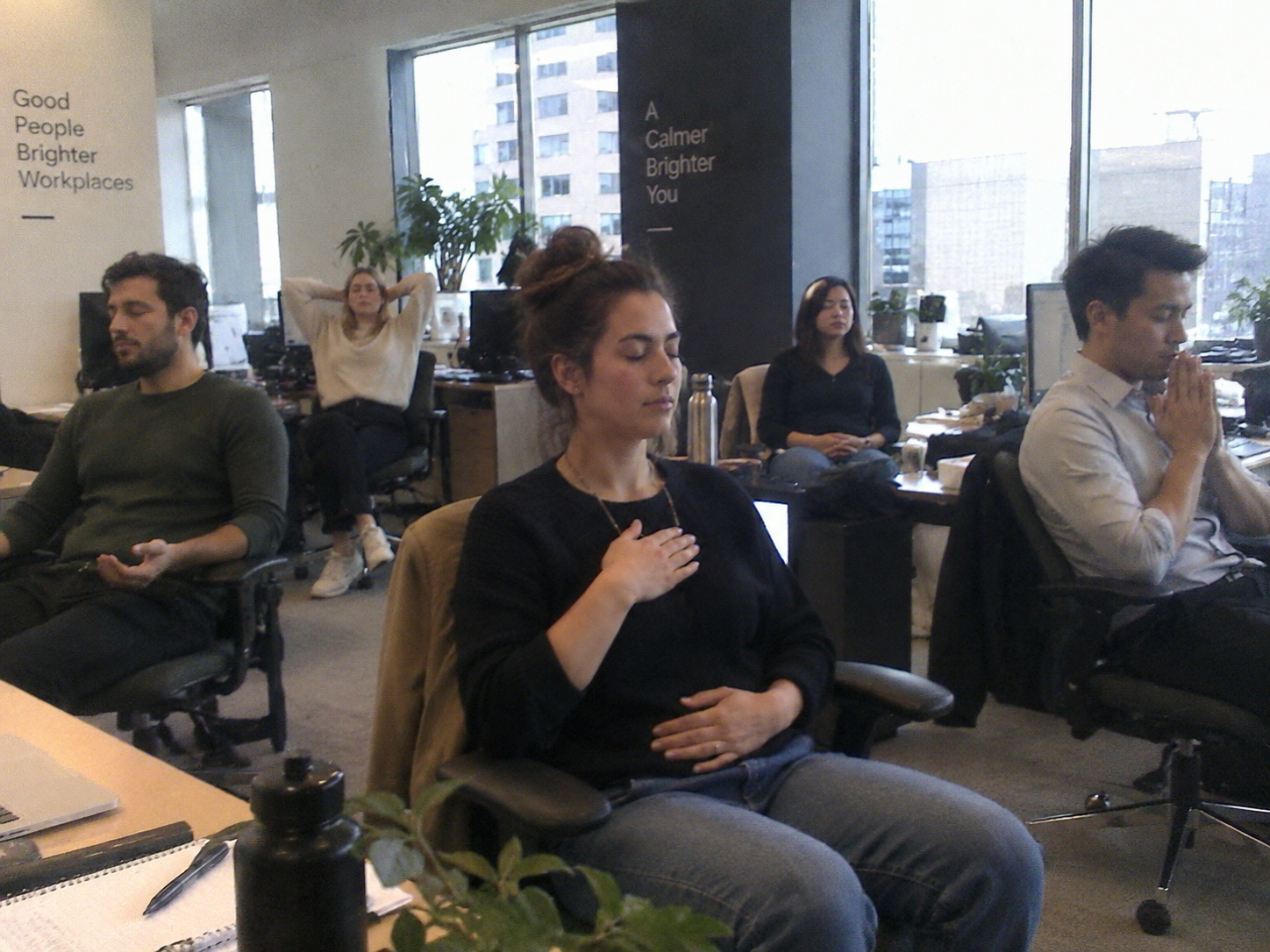
Building a Culture of Calm: Corporate Mindfulness Programs That Work
Handing out a meditation app subscription is a start, but it rarely moves the needle on its own. The organisations that see real results from workplace meditation programs tend to do a few things differently:
They make it visible from the top. Leaders who openly use mindfulness practices signal that it's a legitimate part of how the business operates, not an admission of weakness.
They build it into the calendar, not just the intranet. A recurring 15-minute session is more effective than an optional resource nobody has time to find.
They tailor it to the team. A warehouse team, a call centre, and an executive group all experience pressure differently, and a good corporate mindfulness workshop reflects that.
They measure it. Simple before-and-after pulse surveys on stress and focus give HR real data to justify ongoing investment.
They pair it with structural fixes. Mindfulness helps people cope with pressure. It's not a substitute for addressing chronic understaffing or unrealistic deadlines.
If you're exploring employee wellbeing programs, our workplace meditation sessions are built around exactly this approach: practical, on-site or virtual training tailored to how your team actually works, not a generic script.
Why Melbourne Businesses Are Turning to Corporate Mindfulness
Across Melbourne, more HR and People & Culture teams are treating workplace wellbeing as a genuine performance strategy rather than a compliance checkbox. Whether it's a professional services firm preparing for a high-stakes quarter or a manufacturing team managing shift-based fatigue, corporate mindfulness Melbourne businesses are booking tends to focus on realistic, repeatable habits their people can use immediately, not abstract theory.
We've delivered workplace meditation Melbourne sessions and corporate wellbeing workshops for teams of all sizes, and the pattern is consistent: the businesses that see the biggest shift are the ones that treat mindfulness as a skill to be trained, the same way they'd train negotiation or leadership. You can read more about the measurable impact in our piece on the ROI of corporate meditation.
Getting Started: Employee Stress Management Strategies for HR Teams
If you're building a business case for corporate meditation classes Melbourne teams will actually attend, keep it simple:
Start with a pilot in one team before rolling out company-wide
Choose a time that doesn't compete with lunch breaks or commute windows
Frame it around performance and focus, not just "stress relief," to get buy-in from sceptical managers
Offer a mix of live sessions and short recorded practices for flexibility
Revisit and adjust based on employee feedback every quarter
For teams wanting a low-commitment starting point, our free meditation guide is a good way to introduce the basics before committing to a full program, and our FAQs page answers the questions HR teams ask most often about running sessions on-site.
Calm People Make Better Decisions
Pressure at work isn't going anywhere. Deadlines, targets, and difficult conversations are simply part of professional life. What mindfulness offers isn't an escape from that pressure, but a genuinely useful set of skills for meeting it with a clearer head: better focus, steadier decision-making, and communication that holds up even when things get tense.
For HR teams looking for an employee stress management strategy that's practical rather than performative, workplace mindfulness training is one of the few options backed by real evidence and real employee enthusiasm once they try it.
If you'd like to talk through what a workplace mindfulness training program could look like for your team, whether that's a single workshop, an ongoing series, or something tailored to a specific department, we'd love to help. Contact us for a chat, and we'll design something that actually fits how your people work